
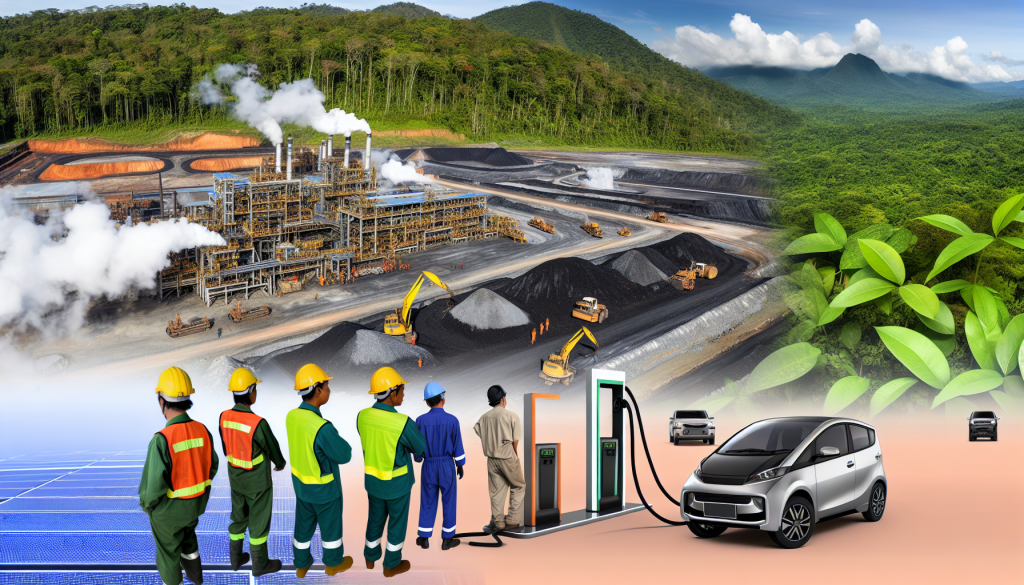
As we continue to witness the remarkable developments in the world of technology and industry, some fascinating shifts are unfolding in the global market. Notably, the recent spike in electronic vehicle (EV) production has significantly intensified the demand for nickel, a crucial component in EV battery production. Intriguingly, China’s influence appears to be dominant in Indonesia’s nickel industry, a trend that aligns quite well with the burgeoning demand incited by the EV boom.
China’s pronounced dominance in Indonesia’s nickel industry
In light of the current trend, Indonesia, renowned for its vast and largely untapped nickel reserves, has inadvertently become the epicenter of a global bidding war. Chinese companies keen on securing reliable sources of nickel have heavily invested in Indonesia, leading to tangible growth in both the mining and smelting sectors of the country’s nickel industry.
With companies such as Tsingshan Holding Group spearheading the nickel supply chain in Indonesia, China has successfully positioned itself to tapping into a significant share of Indonesia’s nickel resources. This strategic move is also indicative of its intent to consolidate its position in the global EV market, currently underpinned by major players including Tesla and BYD.
Implications of China’s growing influence
While China’s incursion into Indonesia’s nickel industry serves its self-interests, it also presents some significant implications. Most prominently, it has an impact on the global supply chain of EV batteries. With China having a dominant grip on Indonesia’s nickel production, it holds considerable sway over the supply of nickel, a key material in manufacturing cutting-edge EV batteries. This could potentially give China an upper hand in setting global nickel prices, particularly at a time when the world is increasingly transitioning towards electric mobility.
Beyond the economic sphere, China’s deep-rooted influence is also sparking environmental concerns. Nickel mining and smelting typically involve processes that could be detrimental to the environment. As such, it is crucial that responsible practices are upheld in this interaction to safeguard both the local environment and global sustainability goals.
The intertwining of tech innovation, resource control, and strategic influence in this scenario is a reminder of how the ripple effects of technological advancements can reach far and wide. Be it the visionary automaker aiming to revolutionize transportation or the pensive investor eyeing profits from a promising mineral, each action taken in response to the EV boom is a testament to the immense power of technology.
Keeping a finger on the pulse of such dynamic transitions helps us foresee potential shifts and opportunities, reinforcing our understanding of how technology can shape economies and influence geopolitical landscapes. After all, as tech enthusiasts and participants in this ever-evolving digital age, staying informed and ahead of the curve equips us better to navigate the maze of technological advancement.
So, as we step further into a future where technology’s influence permeates even deeper into our lives and societies, let’s embrace the complexities and marvel at the endless possibilities it presents. And wherever we may find ourselves in this diverse digital landscape, let’s continue to explore, learn, and grow, always eager to uncover how technology can bring us together and make our lives better.

Liam Nguyen is a tech enthusiast and writer with a genuine passion for all things related to technology and the web. At the age of 32, Liam has already carved out a niche for himself as a go-to source for insights on emerging tech trends, gadget reviews, and practical advice for navigating the digital age. With a Bachelor’s degree in Computer Science from a well-known tech university, Liam combines his technical expertise with a clear, accessible writing style.
Starting his career as a software developer, Liam quickly realized that his true calling was in demystifying technology for the masses. He transitioned to tech journalism, where he now serves as a contributor to a popular online technology news platform. In his articles, Liam covers a broad spectrum of topics, from the latest smartphone releases to in-depth guides on cybersecurity, aiming to keep his readers informed and ahead of the curve.
Liam’s approach to writing is grounded in the belief that technology should empower and connect people. He has a particular interest in open-source projects and the democratization of technology, themes that frequently appear in his work. Liam’s ability to explain complex technical concepts in an engaging and straightforward manner has endeared him to a diverse audience, from tech aficionados to novices looking to get the most out of their devices.
Aside from his written work, Liam is active in online tech communities, participating in forums and social media discussions. He’s also been known to guest lecture at his alma mater, sharing his journey and inspiring the next generation of tech enthusiasts.
Liam’s dedication to the tech community and his knack for clear communication make him an influential voice in the tech and web category, always eager to explore how technology can make our lives better and more connected.


