
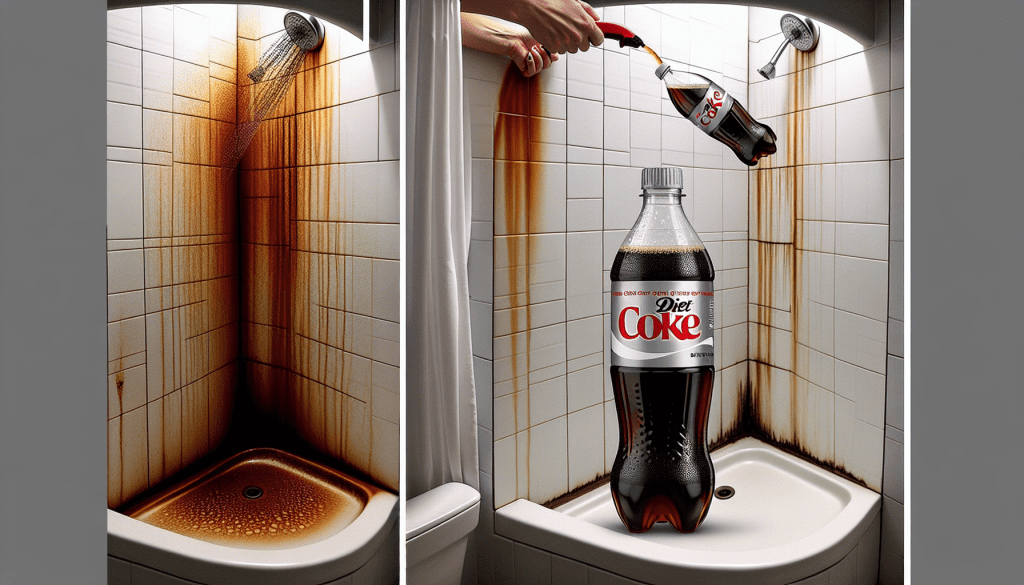
Untangling the conundrums of home maintenance can sometimes feel like a complex puzzle. Today, let’s zero in on one particular issue that folks grapple with regularly – how to effectively deal with rust stains in the shower. Common sense might dictate that getting rid of these stubborn blemishes requires special cleaning products or professional intervention. However, there’s an interesting hack circulating on the Internet that advocates for the use of Diet Coke to tackle shower rust stains, and yes, you read that right – Diet Coke!
Putting the Diet Coke hack to test
Like how an urban legend catches fire and spreads, this hack too has garnered quite a bit of attention online, which got us curious. The proposition is simple and cheap, venturing into the realm of ‘too good to be true.’ But hold on to your skepticism; we decided to go hands-on and put this hack to the test.
First, we doused the rust-strewn areas of the shower with Diet Coke, ensuring a generous application over the stains. The soda was then left undisturbed for about 20 minutes, allowing the fizz and acid to hopefully work their magic on the intractable iron oxide.
Scrubbing and second application
After the initial period had elapsed, we proceeded to scrub away the soda and the loosened rust. With a few stains displaying stubborn resistance, we decided to administer a second round of the soda treatment, once again leaving the fizz to settle in.
The verdict: Does Diet Coke truly work?
Upon a second round of scrubbing and rinsing, we critically examined the results. To our surprise and delight, the rust stains were dramatically lessened with some spots completely clear. There was a definite improvement in the shower’s appearance, all with the aid of a simple household beverage and some elbow grease.
While this tactic may not eradicate every speck of stain, it sure does lessen the intensity significantly. Geared towards sustainability, we just loved the idea of utilizing everyday items in innovative ways for cleaning tasks instead of resorting to harsh chemical cleaners. This also sits well with the principle of ‘waste not, want not’ which we strongly uphold.
Our experiment showed that using Diet Coke is indeed a viable, eco-friendly measure to clean up shower rust stains. However, it’s important to remember its limits. For extremely stubborn spots or widespread issues, it might be worth considering professional help.
Undoubtedly, this clever use of Diet Coke inspires and encourages other such innovative hacks, making chores easier while fostering an urge to experiment and learn. It is a prime example of the kind of community engagement and mutual support we wish to promote – sharing tidbits of practical wisdom that make daily life around the house just a little bit easier.
So the next time there’s some leftover Diet Coke, remember it’s not just for drinking. Get adventurous, repurpose it for a cleaning task, and witness the magic unfold. And remember, the goal isn’t perfection – it’s continuous learning, and making small steps toward sustainability in everything we do.

Emma Johnson is a passionate and insightful writer specializing in the house and garden niche, bringing over a decade of experience to her readers. At the youthful age of 34, Emma has already established herself as a leading voice in home improvement, landscaping, and interior design. Her journey began with a degree in Landscape Architecture from the University of Georgia, followed by years of hands-on experience working with renowned landscaping firms across the country.
Emma’s writing career took off when she started sharing her unique ideas and eco-friendly gardening tips on her personal blog. Her ability to blend practical advice with aesthetic design quickly garnered attention, leading to her current position as a featured columnist for a prominent online news site.
Dedicated to sustainable living and innovative design, Emma’s articles offer a wealth of knowledge, from DIY home projects to the latest trends in garden technology. Her work not only enlightens homeowners looking to enhance their living spaces but also inspires a deeper appreciation for the environment.
When she’s not writing or experimenting in her own garden, Emma enjoys mentoring young designers and participating in community beautification projects. Her contributions extend beyond her written work, embodying her commitment to making the world a more beautiful and sustainable place, one home at a time.


